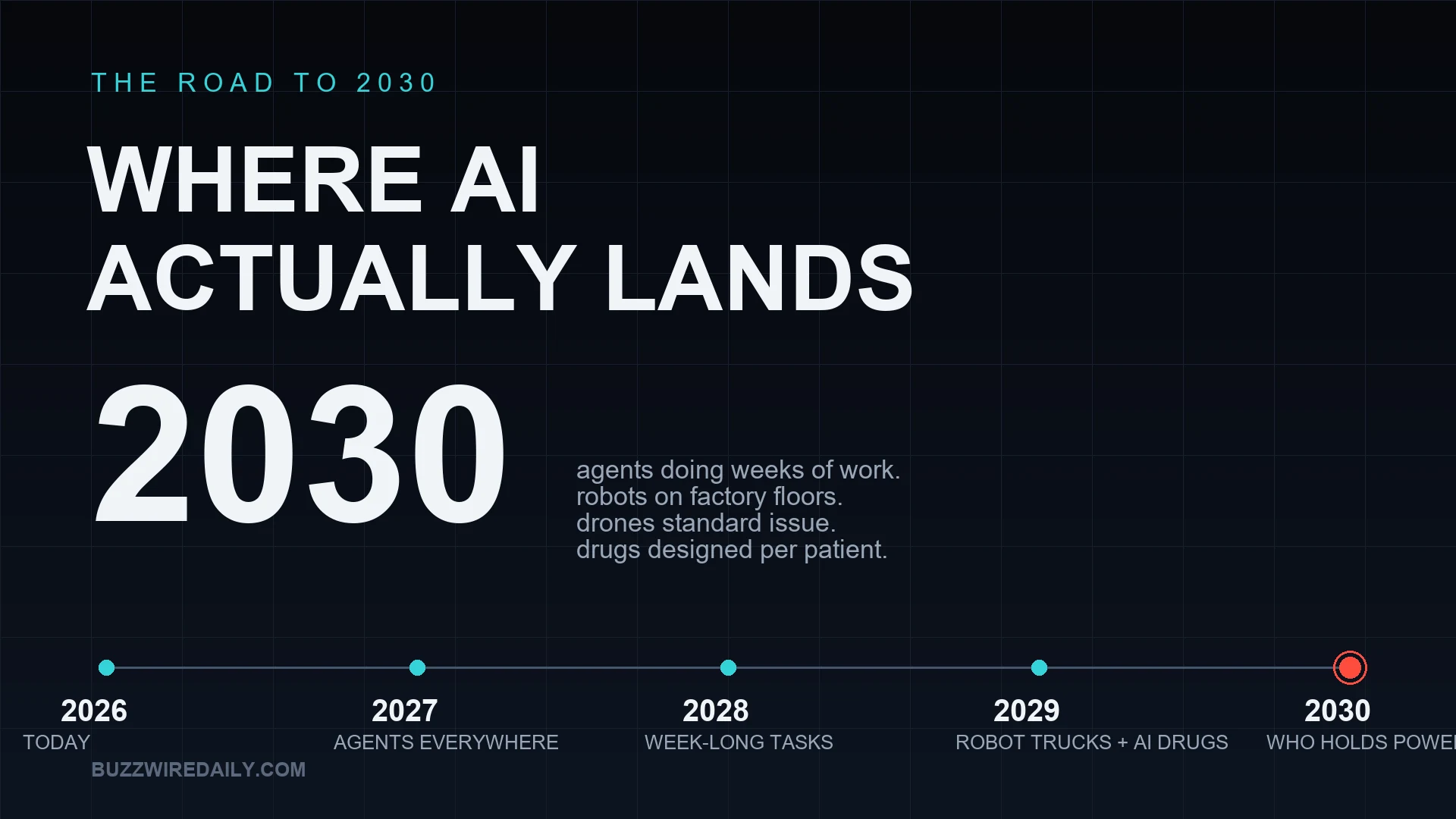
Four years. That is the distance between ChatGPT’s debut and 2030, and it is also the distance between “AI is a chatbot” and the version of the world now taking shape in benchmarks, boardrooms and battlefields. Strip the hype and the denial, and the credible forecast for 2030 reads like this: agents doing week-long work, robot trucks on the highway, the first AI-designed drugs reaching patients, drone fleets as standard equipment, and one question sitting on top of all of it: who holds power when machines need fewer people?
Start with what is already measured, because this part is not a prediction. On OSWorld, the benchmark for ordinary computer work like fixing spreadsheets and clearing inboxes, the best AI scored about 12 percent in 2024 while humans scored 72 percent. Top models now score above 85 percent. The METR lab, which measures how long a job an AI can finish alone, reports the length of those tasks doubling every 4.3 months since 2023, with the frontier already at two full workdays. If that pace even slows to once a year, 2030 ends with AI handling tasks that would take a person weeks.
But capability is not deployment. Stanford economists surveyed nearly 6,000 executives across the US, UK, Germany and Australia and found more than 80 percent of firms report AI changed nothing about their productivity or headcount so far. The gap between what AI can do and what companies have actually done is where most of 2027 through 2029 will happen.
Here is the part for anyone born after 2000. AI is not firing Gen Z. It is just not hiring Gen Z. The same Stanford tracking found employment for 22 to 25 year olds in the most AI-exposed jobs about 19 percent below the older-worker trend, and the mechanism is hiring, not layoffs. SignalFire’s data says new graduates fell from 15 percent of Big Tech hires before the pandemic to 7 percent in 2025, with entry-level hiring down roughly 65 percent at the majors versus 2019. The rung you were supposed to step on is the rung being removed.
The most useful tool in the whole 2030 debate is a three-question test. Is your job on a computer? Can you describe what complete looks like? Can someone check if it’s right? Three yeses and an agent is coming for most of it before 2030. The durable ground is tacit knowledge: nursing, trades, sales, performance, anything learned by being in the room. And the new entry-level skill already has listings: supervising a fleet of agents, the digital version of managing interns.
For Gen Alpha, born 2010 onward and already more than two billion strong, none of this is a forecast. It is the default. They are the first cohort raised inside it: AI tutors, AI toys that safety groups flagged last holiday season, and chatbots that 64 percent of American teens already use. Common Sense Media found 72 percent of teens have tried AI companions and a third have taken serious conversations to one. When forecasters warn that anything on a screen can be faked, remember the deepfake CFO call that cost one company 25.6 million dollars. For kids who have never known a verified feed, trust is a curriculum, not a feature.
The physical world lands last and hardest. Waymo is at about 500,000 paid rides a week across 10 cities and targeting a million by the end of 2026. Figure’s humanoids finished an 11-month run on a BMW line in South Carolina, working 10-hour shifts. Morgan Stanley projects 40,000 humanoid robots by 2030, which sounds enormous until you count the 4 million specialist robots already working in factories. It is a start, not a takeover. Meanwhile the part of the forecast nobody debates is the grim one: NATO officials said drones accounted for about two thirds of Russian tanks destroyed in 2024. Militaries rebuild faster than labor markets, which is why automation arrives in war before it arrives at work.
The bill matters too. The IEA projects global data center electricity demand roughly doubling to about 945 terawatt-hours by 2030, with AI growing from roughly a third to about half of it. OpenAI alone carries hundreds of billions in spending commitments through the decade. Someone pays for the compute the future runs on, and that someone is probably your electricity bill. The hopeful branch survives the audit, though: AI-supported screening in a 100,000-woman Swedish trial caught 29 percent more cancers, an AI system that discovers new materials in hours is already working, and Merck and Moderna’s personalized melanoma vaccine hit its Phase 3 goal in August.
So, where will AI actually be in 2030? Everywhere in software, thin on the ground physically, expensive in energy, and quietly restructuring who gets a first job. The honest critique of any year-by-year forecast, including the confident ones, is that exponential curves have plateaus, and four years ago nobody had heard of an agent. But the closing question survives every audit: when fewer people are needed to project power, fewer people have to agree with whoever holds it. America has the chips. China has the bodies. Gen Z and Gen Alpha get the consequences, and the vote. WIRED turned the question into a career quiz, if you want to test your own answers.