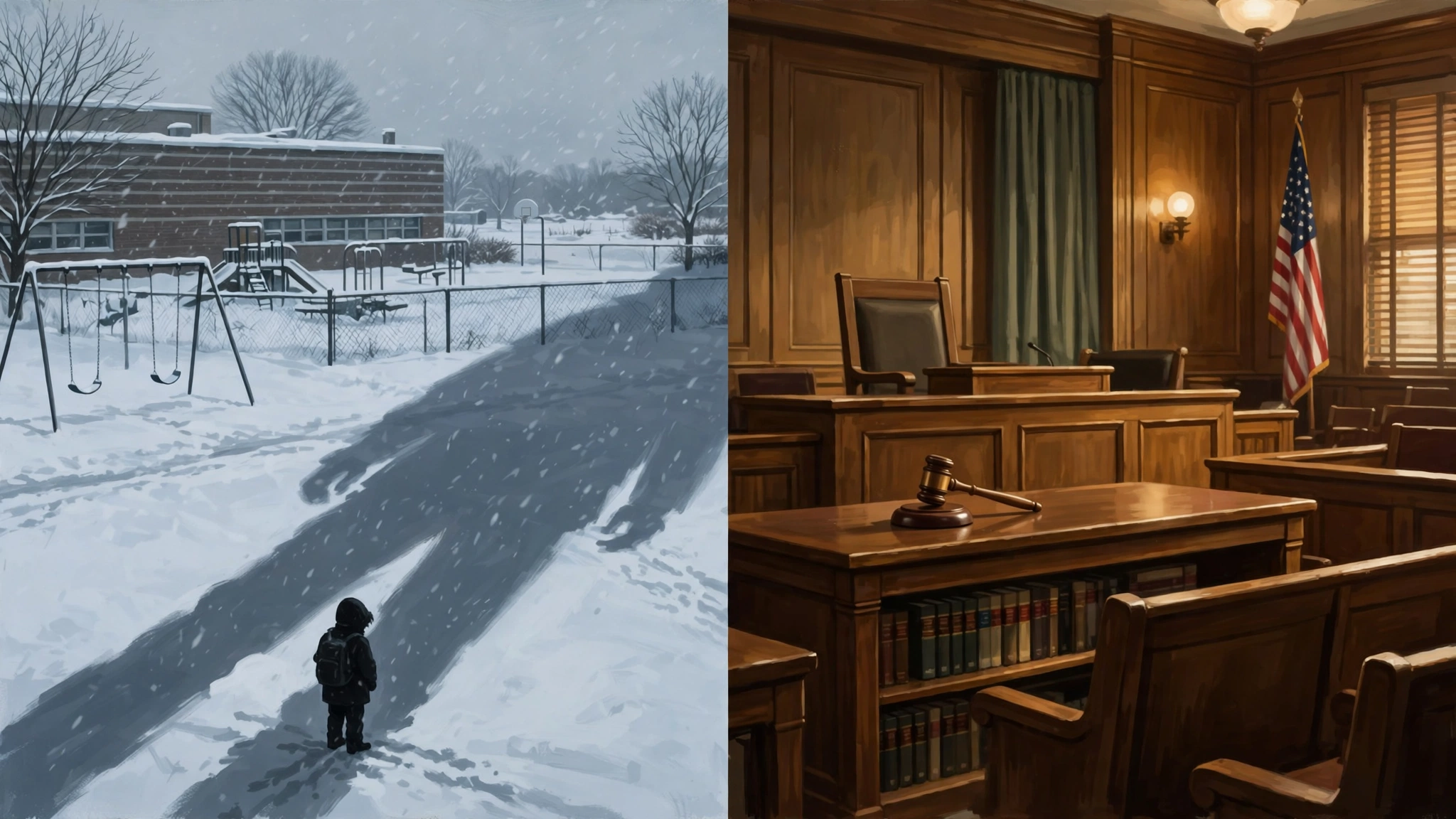
DeAngelo Bailey bullied Marshall Mathers at Dort Elementary School in Roseville, Michigan. Twenty years later, he sued the rapper the world knows as Eminem for $1 million, claiming a song about that bullying had destroyed his reputation. A Michigan judge threw the case out, explained her reasoning in a ten-stanza rap, and an appeals court backed her up.
The detail most retellings miss is why Bailey never stood a chance. The core of his claim had been sitting in a public court file since 1982, placed there by Eminem’s own mother. Her failed lawsuit against the school district became the paper trail that helped kill his.
What happened at Dort Elementary in 1982
Mathers was nine years old and small for his age when he enrolled at Dort Elementary. Bailey was an older, bigger schoolmate. By Debbie Mathers’ account, the attacks escalated through the school year: shoves, stolen belongings, group beatings. In January 1982, Bailey knocked the boy into a snowbank. Mathers was taken to hospital, where, according to his mother, doctors found a cerebral hemorrhage. He spent days under observation with concussion symptoms, nightmares and damaged vision.
Debbie Mathers sued the Roseville school district in 1982, arguing it had failed to protect her son. The case was dismissed in 1983 on governmental immunity grounds, meaning the district could not be held liable in that way. The family got nothing. But the filing mattered. It put the bullying, the injuries and Bailey’s name into a legal record two decades before anyone had heard of Slim Shady.
“Brain Damage” names DeAngelo Bailey on a 1999 album
Eminem told the story himself on “Brain Damage,” a track on The Slim Shady LP, released in February 1999. The song opens the Bailey verse by naming him outright: “Way before my baby daughter Hailie, I was harassed daily by this fat kid named DeAngelo Bailey.” It goes on to describe locker shoves, a bathroom beating, a head smashed against a urinal until his nose broke, and a principal who joins in rather than intervening.
Weeks after the album came out, Bailey talked to Rolling Stone for its 29 April 1999 Eminem profile. He admitted he had bullied Mathers. He framed it as ordinary schoolyard behavior, a bump here, a shove there, but the admission was on the record, in print, in his own words. In the same article, Eminem was quoted saying of the song: “Everything in the song is true.” That pairing shaped everything that followed.
The $1 million Bailey lawsuit, filed December 2001
In December 2001, Bailey sued Mathers in Macomb County Circuit Court. He sought $1 million, arguing the song defamed him and placed him in a false light, a form of invasion of privacy. He said the portrayal had damaged his reputation and hurt his own ambitions as a rapper. He denied the song’s worst specifics: no broken nose, no urinal, no choking.
Eminem’s side conceded ground that sounds damaging until you read the ruling. Some details in the song were invented for the rhyme. The principal never joined a beating. The grade levels in the lyric do not line up with the school records. Eminem’s lawyers argued none of that mattered, because the gist of the song, that Bailey was a bully who tormented a younger, smaller kid, was documented and admitted.
Judge Deborah Servitto’s ruling, and the rap inside it
Judge Deborah A. Servitto granted summary disposition on 17 October 2003, dismissing the case in a 13-page opinion. Her reasoning ran on two tracks.
First, substantial truth. Judged against Bailey’s own Rolling Stone admissions and the 1982 school lawsuit, the song’s central claim was accurate. A defamation or false light claim cannot survive when the sting of the statement is true, even if decorative details around it are embellished.
Second, hyperbole. The bathroom scene, the principal, the cartoon violence: Servitto held that no reasonable listener would take the lyrics as a literal factual report. They were rhetorical exaggeration, protected speech, the kind of heightened storytelling rap runs on.
She also noted a problem Bailey had created for himself. A false light claim requires the portrayal to be highly offensive. Bailey had spent months giving interviews about the song, cooperating with the attention rather than protesting it. The court treated that media tour as evidence he was not offended in the way his lawsuit claimed.
Then came the footnote that made the ruling famous. Servitto summarized her own decision in ten stanzas of verse, including:
“Mr. Bailey complains that his rep is trash / So he’s seeking compensation in the form of cash”
“The lyrics are stories no one would take as fact / They’re an exaggeration of a childish act”
“It is therefore this Court’s ultimate position / That Eminem is entitled to summary disposition”
She later said she wrote it that way to make the verdict universally understandable. Bailey appealed. On 15 April 2005, the Michigan Court of Appeals upheld the dismissal, agreeing that the gist of the lyrics was true by Bailey’s own account and that he had failed to show the song was published with the fault the law requires. Servitto’s own career later followed the case upward: she was appointed to the Michigan Court of Appeals in 2006.
Timeline: two lawsuits, twenty-three years apart
- January 1982: Bailey knocks nine-year-old Marshall Mathers into a snowbank at Dort Elementary. Debbie Mathers says doctors found a cerebral hemorrhage.
- 1982 to 1983: Debbie Mathers sues the Roseville school district for failing to protect her son. Dismissed on governmental immunity.
- February 1999: The Slim Shady LP released. “Brain Damage” names DeAngelo Bailey.
- April 1999: Bailey admits bullying Mathers in Rolling Stone. Eminem says everything in the song is true.
- December 2001: Bailey sues Eminem in Macomb County Circuit Court, seeking $1 million for defamation and false light invasion of privacy.
- 17 October 2003: Judge Deborah A. Servitto dismisses the case, with a ten-stanza rap in her 13-page opinion.
- 15 April 2005: The Michigan Court of Appeals upholds the dismissal.
Why Bailey v. Mathers still gets cited
The case survives in entertainment law because it answers a question artists keep asking: can you name a real person in a song and survive the lawsuit? Bailey v. Mathers says the naming alone is not the problem. What matters is whether the core portrayal is substantially true and whether a reasonable audience understands the work as art rather than affidavit.
It also stands as a warning about the gap between a story and its paperwork. Bailey’s claim failed partly because of things he said himself, to Rolling Stone, for free, years before he hired a lawyer. In 1982 the Mathers family lost to a school district shielded by immunity. In 2001, Eminem’s lawyers were armed with that old court file and Bailey’s own interviews. The bully’s lawsuit was beaten before it was filed, by a record he helped create.
Sources
- Bailey v. Mathers, Michigan Court of Appeals, per curiam opinion, April 2005 (case record via Justia), covering the trial court’s reasoning, the Rolling Stone statements and the substantial truth doctrine.
- Judge Deborah A. Servitto, opinion and order granting summary disposition, Macomb County Circuit Court, 17 October 2003, including the ten-stanza verse footnote.
- Rolling Stone, Eminem profile, 29 April 1999, containing Bailey’s admission that he bullied Mathers and Eminem’s statement that everything in the song is true.
- Debbie Nelson (Mathers), My Son Marshall, My Son Eminem (2008), her account of the Dort Elementary attacks, the January 1982 hospitalization and the 1982 Roseville school district lawsuit.
- Contemporary news reports of the dismissal, October 2003, and of the Court of Appeals ruling, April 2005 (Associated Press and MTV News coverage).
- “Why Eminem Got SUED by His Childhood Bully for $1,000,000” (YouTube video essay), additional source.