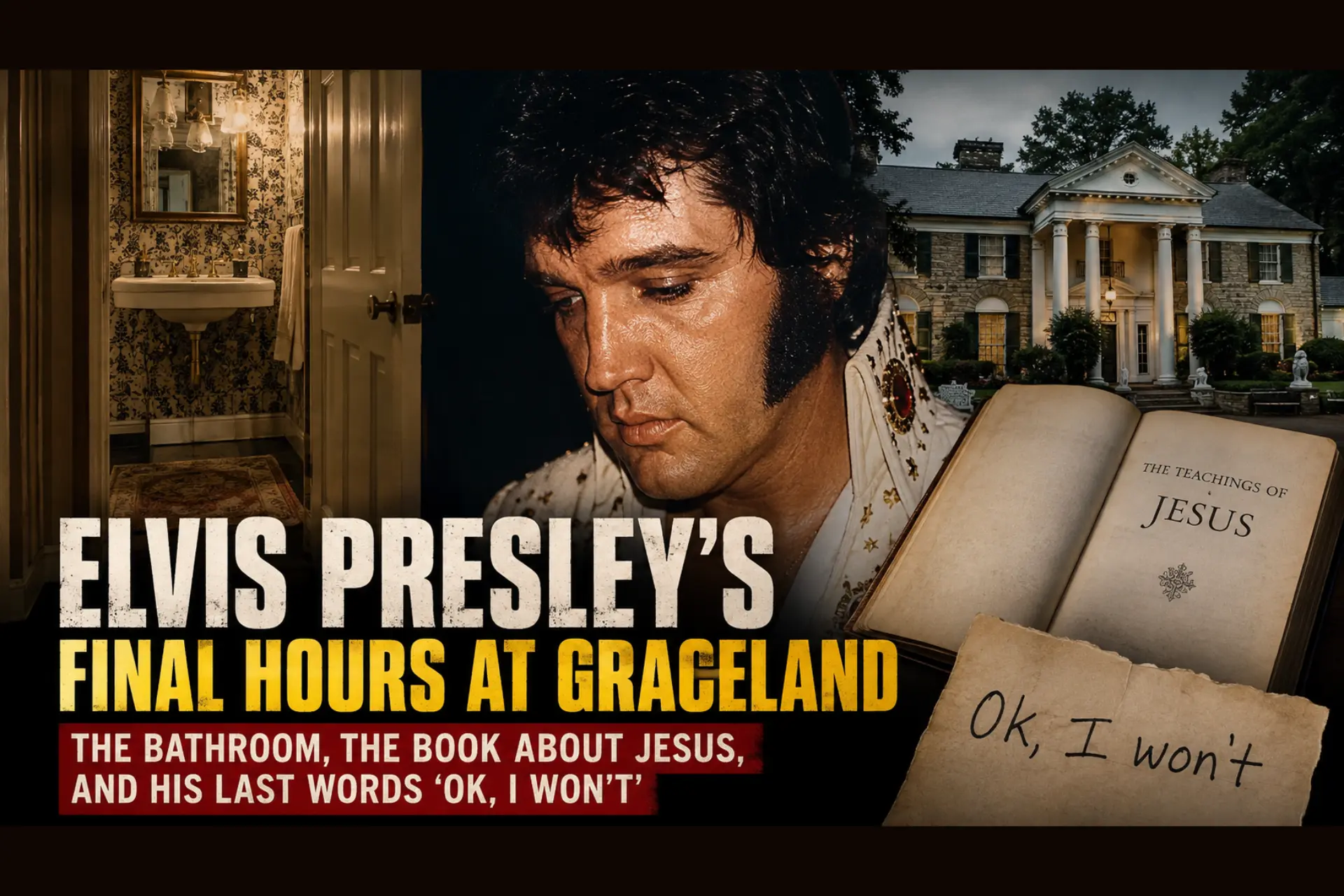
Elvis Aaron Presley, age 42, was found dead on the bathroom floor of his Graceland mansion on the afternoon of August 16, 1977. Hours earlier, in the small hours of the morning, his fiancée Ginger Alden had told him not to fall asleep reading in the bathroom. His reply, as she recalled it years later: “Ok, I won’t.” He had taken in a paperback copy of A Scientific Search for the Face of Jesus by Frank O. Adams. By 3:30 pm Central Time, he was pronounced dead at Baptist Memorial Hospital in Memphis. The King was 42 years old.
Presley had been scheduled to fly out that evening to Portland, Maine, to open another tour. Instead, a single piece of news traveled from a beige mansion on Elvis Presley Boulevard to every major wire service in the country before the dinner hour. President Jimmy Carter released a statement crediting Presley with having “permanently changed the face of American popular culture.” Thousands of fans gathered at the gates of Graceland that night. According to the death account on Wikipedia, the scene outside the mansion remained chaotic for days.
The book Alden remembered him carrying into the bathroom has its own small footnote in the story. A Scientific Search for the Face of Jesus, by Frank O. Adams, was a sincere, mid-1970s attempt to recover a historical likeness from the Shroud of Turin and related relics. It is not the kind of reading material most people associate with the man who sang “Hound Dog” and “Jailhouse Rock.” That detail has fueled decades of Elvis mythology, in part because of the contrast it sets up, and in part because the man who read it never woke up to discuss what he thought of it.
What killed Elvis Presley has been argued over for almost half a century. The death certificate, signed within hours of his arrival at Baptist Memorial, lists the immediate cause as cardiac arrhythmia, an irregular heartbeat. Memphis medical examiner Jerry Francisco announced the same conclusion to reporters before the autopsy was finished, and went further: he told the press that “drugs played no role in Presley’s death.” That last statement would not survive the toxicology report.
Two months later, lab results came back showing fourteen drugs in Elvis’s system, ten of them in significant quantity. Forensic pathologist Cyril Wecht reviewed the toxicology in 1979 and concluded a combination of depressants had caused his accidental death. Peter Guralnick, whose Presley biographies remain the standard account, wrote that “drug use was heavily implicated.” Forensic pathologist Michael Baden, asked years later to weigh in, put it this way: “Elvis had an enlarged heart for a long time. That, together with his drug habit, caused his death. But he was difficult to diagnose; it was a judgment call.” The autopsy was reopened in 1994 by Joseph Davis, the former Dade County, Florida coroner, who argued the opposite: “There is nothing in any of the data that supports a death from drugs. In fact, everything points to a sudden, violent heart attack.” The official cause-of-death record remains cardiac arrhythmia, but the medical community has never reached consensus.
The doctor at the center of the prescription trail was George C. Nichopoulos, known to the family as Dr. Nick. Nichopoulos had been Elvis’s personal physician for years and was well-liked by everyone at Graceland. The numbers that emerged in his 1981 trial, in which he was acquitted of criminal liability, were staggering. In the first eight months of 1977 alone, he had prescribed more than 10,000 doses of sedatives, amphetamines, and narcotics in Elvis’s name. His medical license was suspended for three months. It was permanently revoked in the 1990s, after the Tennessee Medical Board brought new charges of overprescription.
Elvis’s fiancée, Ginger Alden, was 20 years old when he died. She had been born on November 13, 1956 at the US Naval Hospital in Millington, Tennessee, where her father Walter was a public relations officer in the US Army. She first met Elvis as a five-year-old at a Memphis event, then again when she was 20 and he was 41. Two months into the relationship, he proposed with an 11.5-carat diamond ring he had reset from his famous TCB (Taking Care of Business) ring. Their wedding was set for December 25, 1977, five months after the night he told her “Ok, I won’t.” In 2014, Alden published Elvis and Ginger (Ace Books, ISBN 978-0-425-26633-5), the memoir in which she recounted the night of his death. Her husband Ron Leyser died on August 16, 2015, exactly 38 years to the day after Elvis. The coincidence has become its own small piece of Elvis lore.
The bathroom scene, as Alden told it, ran this way. Around 4:00 am on August 16, she noticed Elvis heading toward the bathroom with a book. She told him not to fall asleep in there. He said, “Ok, I won’t.” She woke around midday and found him unresponsive on the bathroom floor, his body in a seated position in front of the toilet. He was not breathing. Paramedics were called. They worked on him at Graceland, then in the ambulance, then at Baptist Memorial. At 3:30 pm, he was pronounced dead.
He was not the only Presley born that January morning in 1935. Thirty-five minutes before Elvis drew his first breath, his identical twin Jesse Garon Presley had been stillborn. Elvis never publicly discussed the twin in depth, but the loss marked him. Years later, when his only child Lisa Marie was born, he named her after her. The Presley family tombstone at Graceland reads “Jesse Garon Presley,” without an apostrophe. Elvis’s own middle name appears in two spellings across the historical record: his birth certificate reads “Aron,” without the second “a,” and that is the spelling on his gravestone. He sometimes used “Aaron” in private, reportedly preferring it. The minor inconsistency has fueled conspiracy theories for decades, most of them unserious.
The aftermath played out publicly. Elvis’s funeral was held at Graceland on August 18. About 80,000 people lined the processional route to Forest Hill Cemetery, where he was buried next to his mother Gladys. Outside the gates that day, a car crashed into a group of fans, killing two young women and critically injuring a third. Elvis’s cousin Billy Mann accepted $18,000 (about $96,000 in 2025 dollars) to photograph the body in its open casket. The picture ran on the cover of the National Enquirer’s biggest-selling issue ever. Alden struck a $105,000 deal with the same outlet for her story, but settled for less after breaking the exclusivity clause. Elvis left her nothing in his will.
Within weeks, an attempt was made to steal the body from Forest Hill. The Presley family had Elvis and his mother exhumed and reburied at Graceland’s Meditation Garden on October 2, 1977, where they remain. “Way Down,” released shortly before his death, topped the country and UK singles charts. Between 1977 and 1981, six posthumously released Presley singles reached the country top ten. Graceland opened to the public in 1982 and now draws more than half a million visitors a year, second only to the White House among American homes. It was declared a National Historic Landmark in 2006.
None of that resolved the question of how a 42-year-old man in possession of his faculties, with a tour date hours away, ended up dead on his own bathroom floor with a book about Jesus open in front of him. Elvis Presley had lived faster and louder than almost anyone in twentieth-century entertainment. The prescription records make that plain. So does the medical examiner’s hasty statement that drugs played no role, a claim undone two months later by his own lab. So does the tour bus that never left Memphis that night. The bathroom scene, as Ginger Alden preserved it, is small and strange and not fully explained by any of the medical literature that has piled up around it. That is part of why the date keeps coming back around.