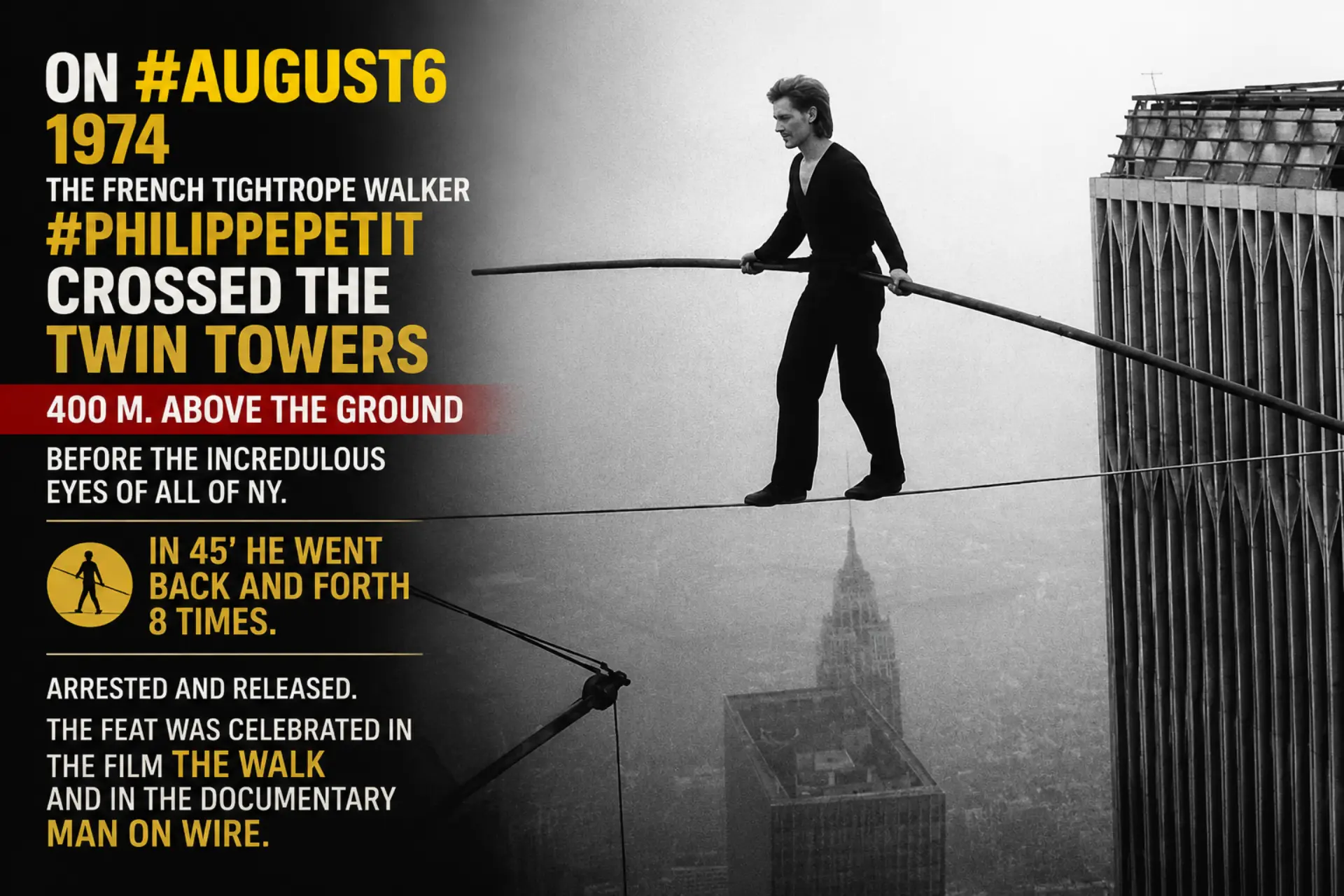
On the morning of August 7, 1974, Philippe Petit stepped from the roof of the south tower of the World Trade Center onto a steel cable stretched roughly 140 feet to the north tower, 1,350 feet above the streets of Lower Manhattan.
The 24-year-old French high-wire artist, dressed in black and carrying a long balancing pole, crossed the gap eight times over the next 45 minutes. He walked, knelt, lay down on the inch-thick cable, and paused to look at the gathering crowd below before stepping back onto solid ground and surrendering to waiting officers from the Port Authority of New York and New Jersey.
Petit was born August 13, 1949, in Nemours, France, the son of a French Army pilot. He taught himself juggling and magic as a child, then learned tightrope walking as a teenager. By the early 1970s he had already completed unauthorized walks between the towers of Notre-Dame Cathedral in Paris in 1971 and the pylons of the Sydney Harbour Bridge in 1973.
The idea of walking between the Twin Towers came to him years earlier. While waiting in a Paris dentist’s office as a teenager, he saw an article about the planned buildings that included an artist’s rendering of the two towers. Petit later said he immediately imagined a line connecting their rooftops.
He spent months studying the nearly completed towers, making roughly 200 visits in various disguises—construction worker, journalist, architect—taking measurements and photographs. He hired a helicopter for an aerial survey of the roofs and recruited a small team that included Jean-Louis Blondeau, who fired the first line across the gap, and Barry Greenhouse, an employee who worked on the 82nd floor of the south tower and provided an inside point of access.
On the afternoon of August 6, 1974, Petit and his accomplices entered the buildings with equipment hidden in a van and under false identification. One team, dressed as construction workers for a fictional “Fisher Industrial Fence Co.,” took a freight elevator to the upper floors of the south tower. Another group entered the north tower. Security patrols forced them into hiding for hours. One accomplice fled after realizing they were crouched on a beam above an open elevator shaft. The remaining men waited until after dark, then reached the roofs.
Blondeau used a crossbow to shoot an arrow carrying a fishing line across the void. Heavier ropes and finally a steel cable weighing several hundred pounds followed. Guy wires were tensioned through the night. By roughly 7 a.m. the cable was ready. Petit changed into his performance clothes, wrote his name and the date on a beam, and stepped out.
Officers reached the roofs while he was still on the wire and shouted for him to come in. One reportedly warned that he would come out after him. Petit smiled, continued crossing, and at times turned back toward the middle of the cable when officers reached for him. A crowd of several hundred formed on the plaza and surrounding streets, creating a traffic jam. Construction workers and office workers watched from windows.
After about 45 minutes Petit returned to the roof and was handcuffed. He was taken first to Beekman Downtown Hospital for a psychiatric evaluation, then booked on charges of criminal trespass and disorderly conduct. Under the details of the complaint an officer wrote simply “Man on Wire.”
Manhattan District Attorney Richard H. Kuh later agreed to drop the charges if Petit would give a free performance for children in a city park. Petit accepted. On August 29, 1974, he walked a cable in Central Park between trees near Belvedere Castle.
Asked why he had done it, Petit told reporters, “If I see three oranges, I have to juggle. And if I see two towers, I have to walk.” He has consistently described the walk as an artistic act rather than a stunt, calling it the “artistic crime of the century.”
The episode became the subject of James Marsh’s 2008 documentary Man on Wire, which won the Academy Award for Best Documentary Feature, and Robert Zemeckis’s 2015 feature film The Walk, with Joseph Gordon-Levitt portraying Petit. Petit later settled in the United States and continued performing, including a 1989 walk to the second level of the Eiffel Tower marking the bicentennial of the French Revolution. He has served as artist-in-residence at the Cathedral of St. John the Divine in New York.
The Twin Towers stood until September 11, 2001. Petit’s crossing remains one of the most widely documented unauthorized high-wire walks in history, carried out without a net or harness at a height that left no margin for error.