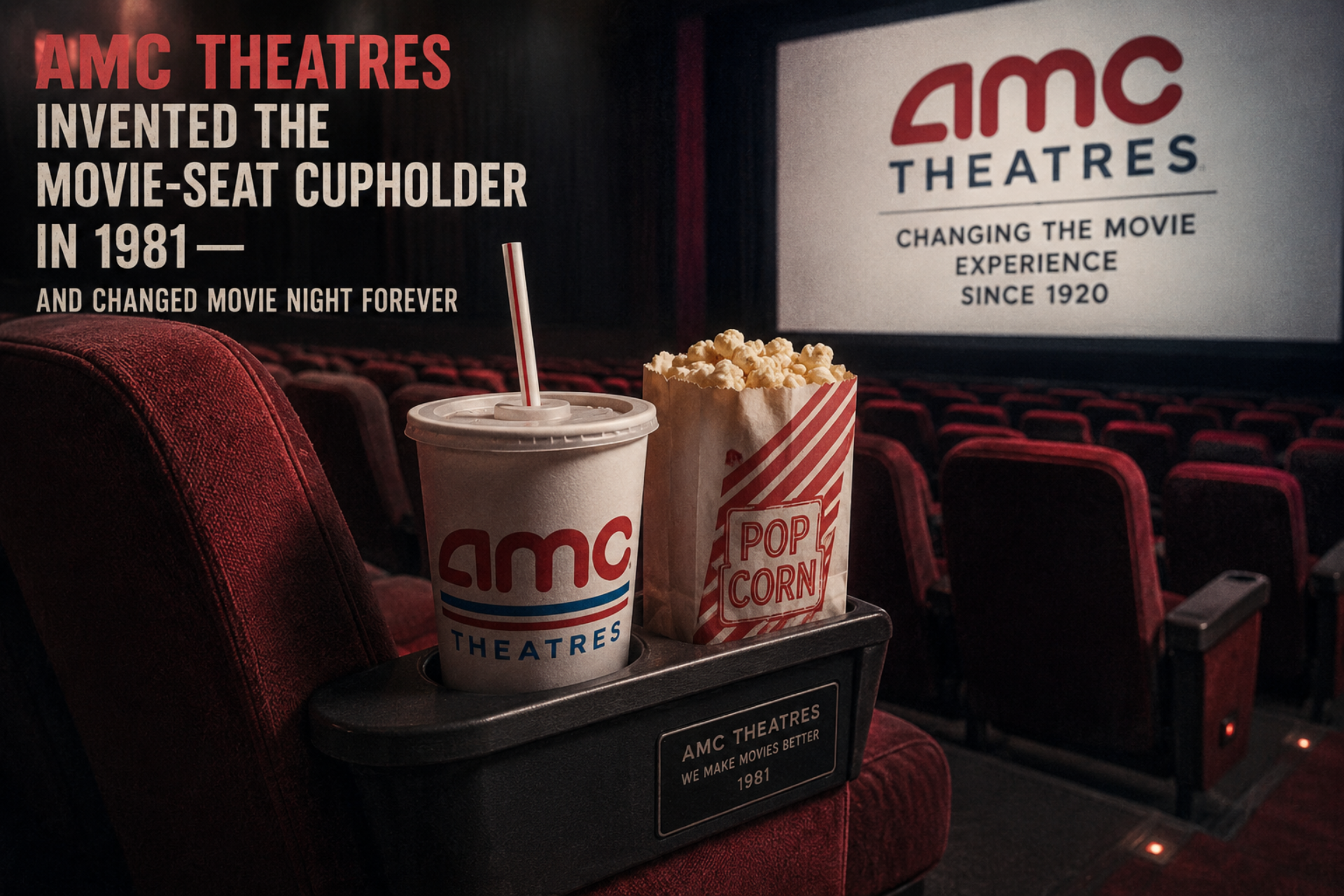
In 1981, AMC Theatres became the first major movie theater chain to install cupholders in the armrests of its seats, a change that soon became standard across the industry.
According to AMC’s official corporate history, that year the company added cupholder armrests throughout its circuit. Before the addition, patrons commonly balanced drinks on their laps, on the floor, or between their knees. The molded receptacle at the end of the shared armrest gave audiences a secure place for soft drinks and cut down on spills in darkened auditoriums.
AMC was then under the leadership of CEO Stanley Durwood. The company traced its roots to 1920, when Maurice, Edward and Barney Dubinsky purchased the Regent Theatre in Kansas City, Missouri. Durwood later took control, renamed the business American Multi-Cinema, and in 1962 opened the Parkway Twin in Kansas City, widely recognized as the world’s first multiplex. The cupholder followed as one more practical step intended to improve comfort and support concession revenue.
A 1998 Variety timeline cited by Wikipedia and other secondary sources states that AMC patented cupholder armrests in 1981. A subsequent U.S. patent, No. 4,863,134, issued in 1989 to inventors John R. Young and Larry L. Jacobson and assigned to American Multi-Cinema Inc., described a combination armrest and cup holder. That design used a receptacle with two coaxial bores of different diameters separated by a ring step, allowing it to hold small, medium and large cups. The inner walls were angled to match the taper of typical theater soft-drink cups, increasing surface contact and reducing the risk of tipping or collapse.
Patent records show the 1989 grant was a continuation of applications filed in 1986 and 1987, consistent with design refinements after the initial 1981 installations. The unit attached to the shared chair arms already common in theater rows and extended only far enough beyond the arm to secure a cup without blocking the aisle.
The timing coincided with the growing importance of concessions. After theaters expanded food and drink sales in the mid-20th century, soft drinks and popcorn became significant revenue sources. A dedicated holder made larger beverages more practical for customers and supported higher sales. Other chains adopted similar armrests in the years that followed, and the feature became routine in commercial theaters.
AMC continued updating the physical experience of moviegoing. In 1995 the company opened what it describes as the world’s first megaplex and introduced stadium seating together with LoveSeat-style armrests that could be raised. Later renovations brought power recliners that still incorporated cupholders as a standard element.
The cupholder itself is now an ordinary part of most theater seats. The 1981 installation by AMC remains the earliest documented case of a major chain making the feature permanent.