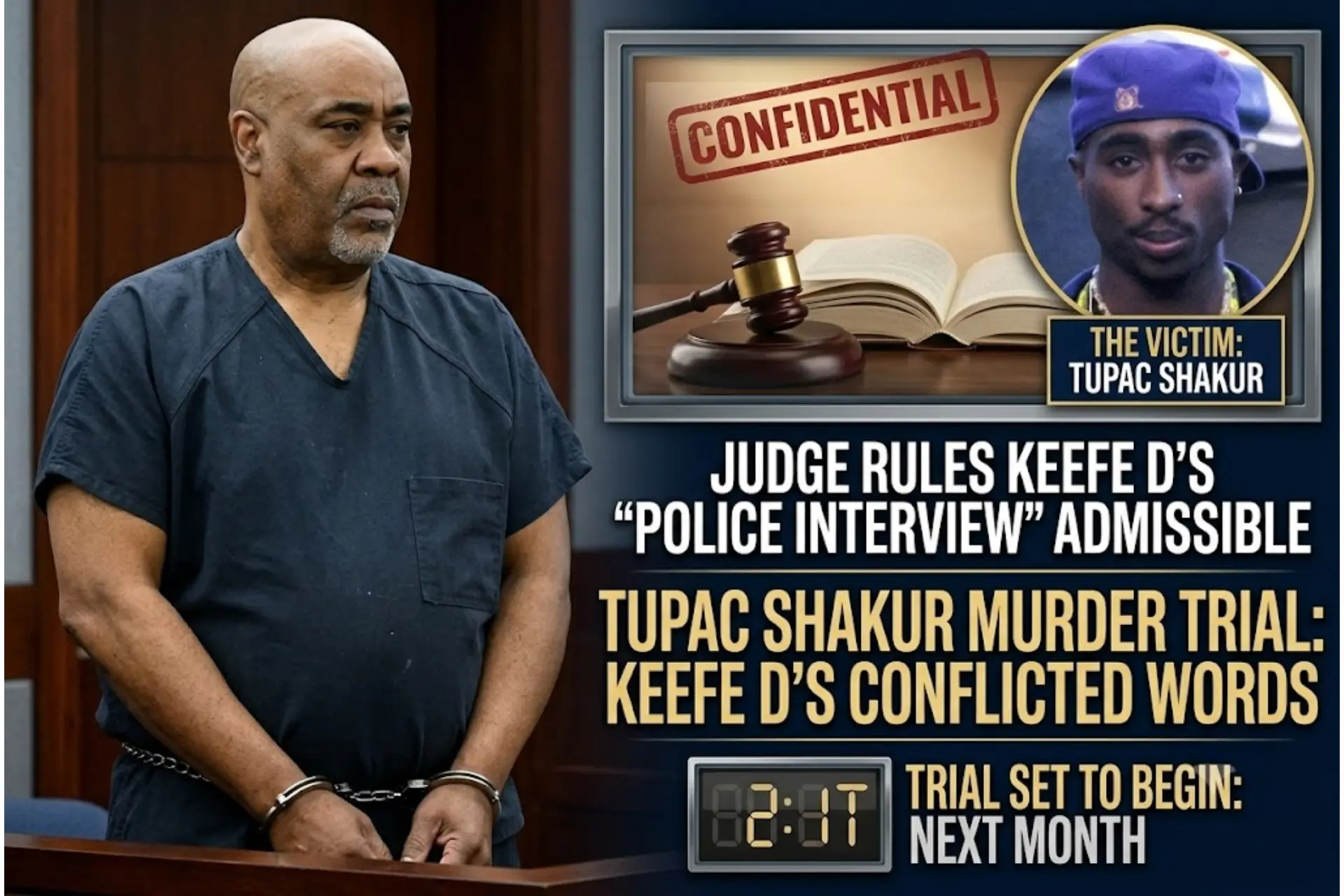
Almost thirty years after shots rang out on a Las Vegas street, the only person ever charged in Tupac Shakur’s killing is finally headed to trial. Duane Keith Davis, better known as Keefe D, faces first-degree murder with a deadly weapon and a gang enhancement. At 63, a conviction would mean the rest of his life behind bars with no chance of parole. Jury selection starts August 10 in Clark County District Court before Judge Carli Kierny, after years of delays and a string of pretrial rulings that have mostly gone the prosecution’s way.
On Tuesday, July 28, Kierny delivered another setback to the defense. She ruled that a 2008 police recording of Davis can be played for the jury. In that interview, Davis described spotting Shakur and Death Row Records founder Marion “Suge” Knight at a red light near the Strip on the night of September 7, 1996. He and three other South Side Compton Crips were in a white Cadillac. According to the tape, Davis said his nephew, Orlando “Baby Lane” Anderson, “popped them”—the shots that hit Shakur four times and wounded Knight. Defense attorney Michael Sanft argued the interview was supposed to stay confidential, that detectives had promised Davis the words would never be used against him. Prosecutors said any such promise died the moment Davis put the same story in his 2019 memoir “Compton Street Legend” and kept repeating it in interviews and documentaries. The judge agreed the recording comes in.
The book is coming in too. Earlier this summer Kierny turned down Sanft’s bid to keep “Compton Street Legend” out of evidence. She noted that Davis himself had called the memoir the real truth more than once. In its pages he writes that he got a handgun from an associate, tossed it into the back seat of the Cadillac, and rode up front as the car pulled alongside Shakur’s BMW. He never names the shooter in the book, but the 2008 recording points straight at Anderson. Prosecutors say Davis, then a ranking shot-caller for the South Side Compton Crips, ordered the hit as payback for a fight hours earlier inside the MGM Grand. Surveillance video shows Shakur and Knight’s crew beating Anderson in the hotel lobby right after a Mike Tyson fight. Anderson always denied any part in the shooting and was never charged. He died in an unrelated Compton gang shootout in May 1998.
Davis was arrested in September 2023 at his house in Henderson, Nevada, after a grand jury indicted him. By then the case had gone cold for more than twenty years. Investigators only reopened it because Davis wouldn’t stop talking. The 2008 interview first reached a wider audience in former LAPD detective Greg Kading’s book “Murder Rap.” Clips later showed up in documentaries, including the recent “Sean Combs: The Reckoning.” Davis has said he was just telling the truth after years of silence. His lawyers now argue the stories were pumped up or made up for money and that Davis never pulled a trigger. The other three men said to have been in the Cadillac—Anderson, Deandre “Freaky” Smith, and Terrence “Bubble Up” Brown—are all dead. That leaves Davis as the last man standing.
Shakur was 25 when the bullets hit. He was rushed to University Medical Center and held on for six days before dying of his wounds on September 13, 1996. Knight walked away with lesser injuries. The shooting set off a wave of retaliatory violence between Crips and Bloods in Compton that one local detective later called “ten days of hell.” For years the investigation limped along on conflicting tips, missing evidence, and the steady loss of potential witnesses. Davis’s choice to put his version of that night on the record finally gave prosecutors someone still alive to charge.
The trial is expected to last about four weeks. Jurors will hear about an earlier scuffle at a Foot Locker in Lakewood, California, where Anderson and other South Side Crips allegedly tried to snatch a Death Row medallion from one of Knight’s associates. They will hear about the MGM Grand fight, the rented Cadillac, the .40-caliber Glock that was never found, and the long list of statements Davis has made over the years. Sanft plans to attack the reliability of those statements and argue that his client is on trial mainly for talking too much, not for any proven act. Chief Deputy District Attorney Marc DiGiacomo has already told the court that if Davis had simply stayed quiet, he probably never would have been charged at all.
Davis has been locked up without bail since the arrest. He has switched lawyers more than once and picked up a separate conviction for a jailhouse fight while waiting for trial. At a recent hearing his adult son got a sharp warning from a bailiff after speaking out loud in reaction to one of the judge’s rulings. The courtroom is expected to be packed when jury selection starts in August. After nearly three decades of rumor, conflicting stories, and questions that never got answered, a Las Vegas jury will decide whether the man who spent years describing the night Tupac was shot is the one who set it all in motion.