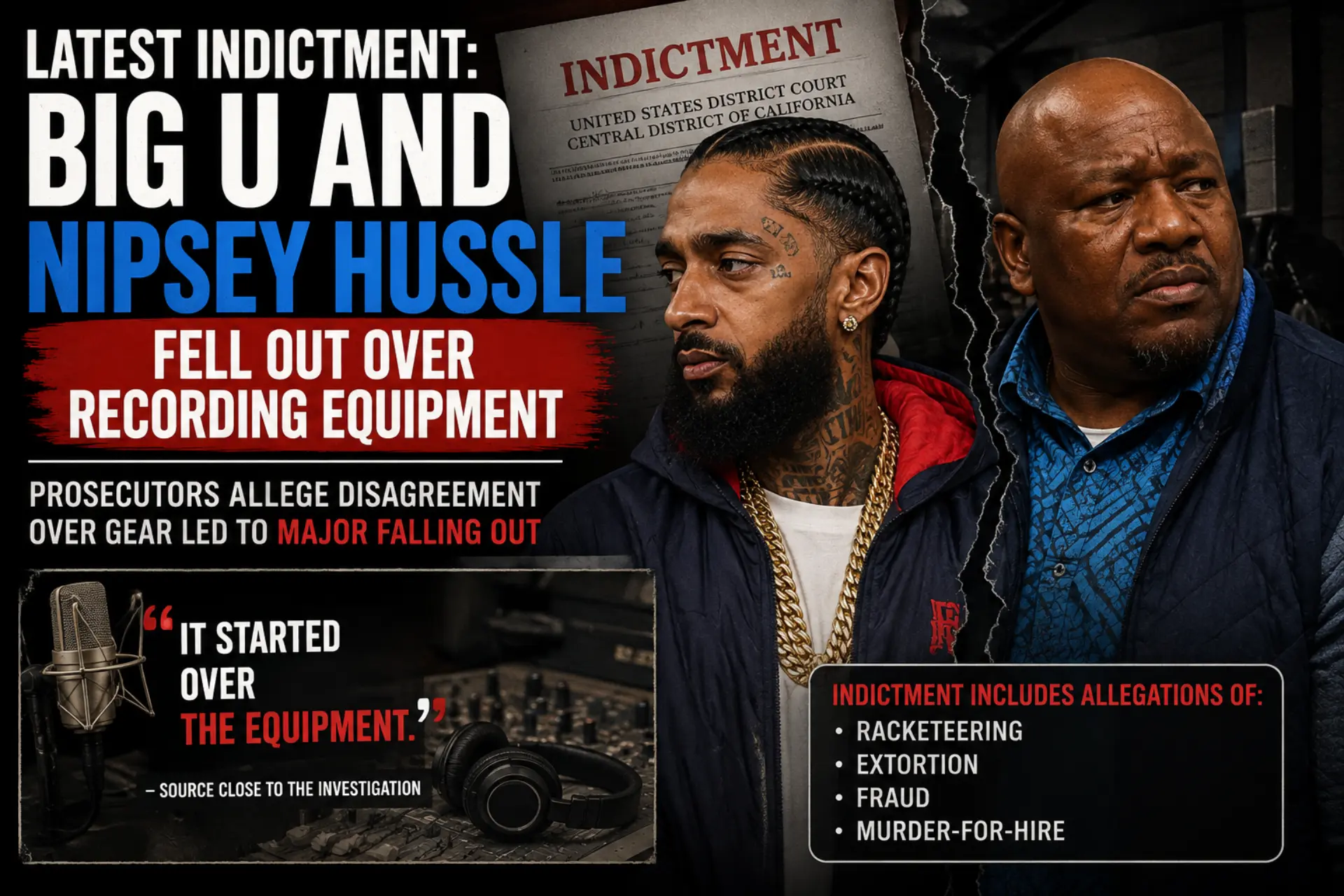
A second superseding federal indictment unsealed this week against Eugene Henley Jr., better known as Big U, lays out how a 2011 argument over recording gear and a Nipsey Hussle diss track ended their mentorship and pushed Henley to try to “discipline” the young rapper.
According to the second superseding indictment filed in the U.S. District Court for the Central District of California, Henley asked for music equipment that Ermias Joseph Asghedom — the South L.A. artist who performed as Nipsey Hussle — had in his possession around 2011. The request turned into a dispute.
Hussle answered with a track called “U Don’t Got a Clue.” The indictment states that Henley perceived the song as targeting him. In or around March 2011, after the song dropped, Henley allegedly picked Hussle up intending to discipline him over the lyrics, describing him in the charging papers as “a scrapper, not a rapper.”
Hussle’s brother stepped in and blocked the confrontation, according to the indictment. Earlier court filings in the same case noted that the situation turned physical and that Los Angeles Police Department officers responded to a scene where a firearm was present and discharged. No injuries were reported.
Henley, 59, from the Hyde Park section of Los Angeles, is described in the indictment as a self-admitted original gangster, or OG, of the Rollin’ 60s Neighborhood Crips. He co-founded the independent label Uneek Music and later ran the nonprofit Developing Options, which received substantial grants from the City of Los Angeles Mayor’s Office Gang Reduction and Youth Development program. Prosecutors allege those efforts masked a racketeering enterprise engaged in extortion, robbery, fraud, human trafficking, and murder.
Asghedom, born in 1985, came up in the Crenshaw district and built his name on independent mixtapes that stressed self-reliance and local pride. Court records and earlier reporting establish that Henley played a role in the early stages of his career. Hussle lived for a stretch with Henley’s family and recorded some of his first tracks in their downstairs studio. The two still appeared together at public events years later, including a 2018 music collaboration launch in Atlanta.
The indictment does not accuse Henley in connection with Hussle’s killing. On March 31, 2019, Asghedom was shot dead outside his Marathon Clothing store on Crenshaw Boulevard in South Los Angeles. Eric Ronald Holder Jr., another Rollin’ 60s member, was convicted of first-degree murder in state court and sentenced to 60 years to life.
The new charging document, returned by a federal grand jury and unsealed around July 29, 2026, broadens the case against Henley and six co-defendants. It adds counts of solicitation to commit a crime of violence and witness tampering tied to an alleged June 2026 attempt inside jail to pay two inmates to kill or injure a witness identified as Victim-1. Fresh allegations also cover interstate transportation for prostitution and additional wire-fraud counts linked to a COVID-19 disaster loan application for Henley’s Celebrity Socks company.
Henley has been held in federal custody since March 2025, when he turned himself in after the original complaint accused him of running what prosecutors call the Big U Enterprise. Court documents state the group required professional athletes and musicians visiting Los Angeles to “check in” with Henley for protection — a practice he discussed on a podcast of the same name. He also faces charges connected to the January 2021 killing near Las Vegas of an aspiring artist signed to Uneek Music who had recorded a song viewed as disrespectful.
The case is captioned United States v. Eugene Henley Jr. et al., No. 2:25-CR-211(B)-FLA. Trial for Henley and the co-defendants is set for February 2027. His lawyers have not publicly addressed the specific claims about Hussle. Henley has previously described the larger case as baseless character attacks in social-media posts.
The 2011 episode detailed in the indictment shows how street expectations and the music business could collide in South Los Angeles. What started as a request for recording gear, according to prosecutors, turned into a public diss track and an attempted act of discipline that family intervention stopped short.