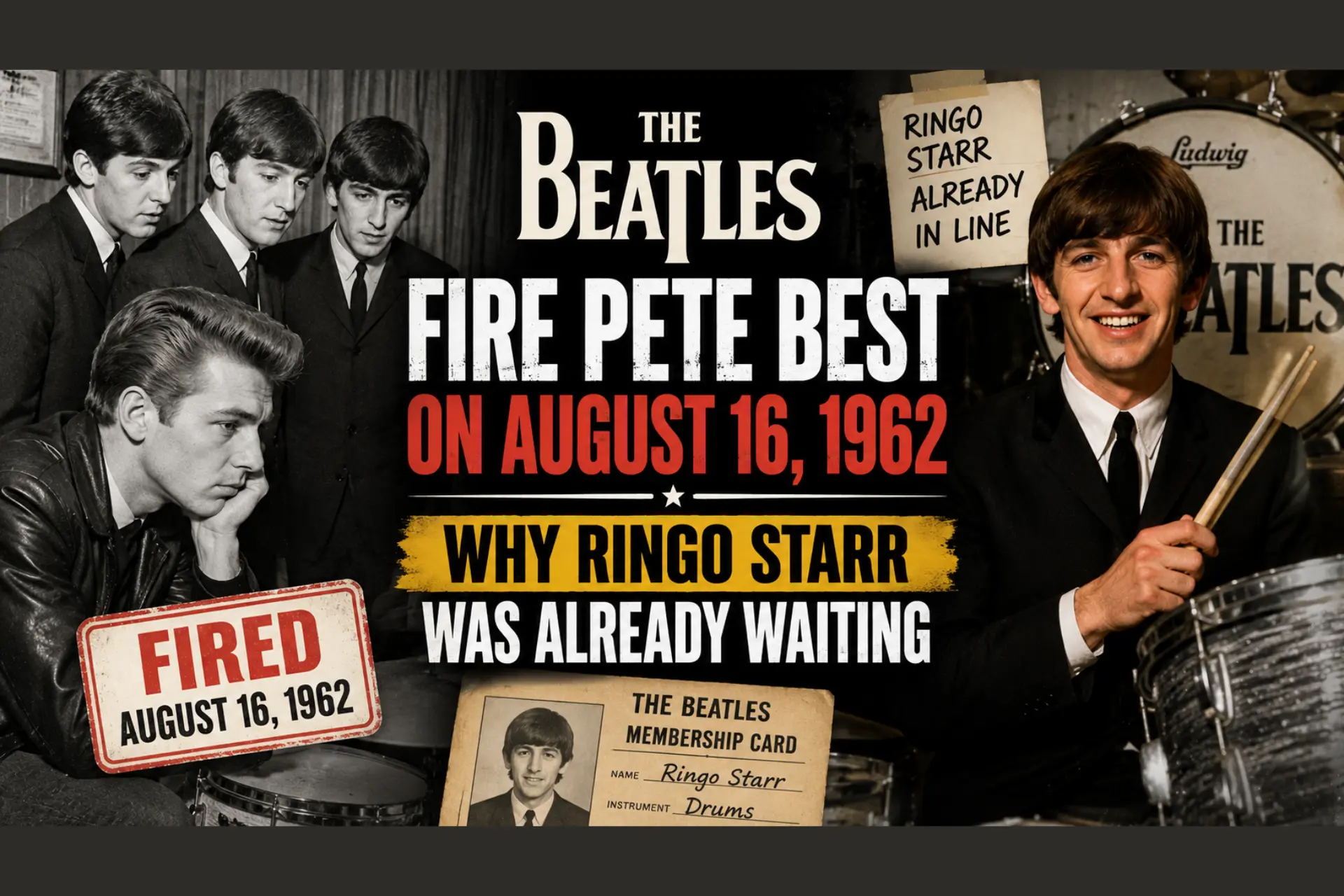
The Beatles fired their drummer Pete Best on the morning of August 16, 1962, and the decision was not his to argue. Brian Epstein, the band’s manager, called Best into his NEMS record shop office on Whitechapel, Liverpool, and delivered the message the other three Beatles had asked him to carry. They wanted him out and Ringo Starr in. Best was stunned. He asked why. He was told he was not a good enough drummer. He agreed, at first, to play a couple of the band’s upcoming gigs, then changed his mind and did not show up for them. The date, sixty-four years before this article was filed, is one of the hinge points of popular music.
The firing did not come out of nowhere. It had been building since late spring. On May 9, 1962, George Martin met Epstein at the Abbey Road studios and agreed to sign the Beatles, impressed by Epstein’s enthusiasm and by what he heard on the band’s earlier Decca audition tape. Martin had not yet seen the group perform live. On June 6, the Beatles walked into Studio Two at Abbey Road for their first contracted recording session, a session the label called a “commercial test.” According to the biographical account on Wikipedia, it was during that session that Martin silently signaled he preferred a more reliable studio drummer than Best.
Between the June 6 session and the August 16 firing, ten weeks and a day passed. Lennon, McCartney, and Harrison had been leaning toward Ringo for some time, from earlier sit-ins and from knowing him in the dingy clubs of Liverpool and Hamburg. They told Epstein to act. Epstein, the polished London-dressed manager from a retail background, was the one who had to sit across a desk from a 21-year-old drummer with a devoted following and explain that the band wanted him gone.
Pete Best had been the Beatles’ drummer since 1960, through the early Hamburg residencies and the Liverpool scene centered on the Cavern Club. His mother, Mona Best, ran the Casbah Coffee Club, which had hosted some of the band’s earliest Liverpool gigs and which gave the Best family a foot in the scene that most of the other early Beatles families did not have. As a live drummer, Best had a loud, straightforward backbeat that crowds liked, and he had a steady following of his own among young women in the audience, a factor that some later accounts suggested made the change politically awkward inside the group.
George Martin’s preference was the decisive ingredient, and it was technical rather than personal. Martin wanted the band’s records to sound a certain way in the studio, and he did not think Best’s playing delivered that. In the standard account, he did not order the Beatles to change drummers. He let his preference be known, and the band, which had its own reasons to prefer Ringo, acted on it. That division of labor, a producer signaling and a band responding, is why the August 16 meeting unfolded the way it did.
The immediate aftermath was rough. Epstein asked Best to play with the Beatles on the sixteenth and seventeenth at the Riverpark Ballroom in Chester. Best said yes, then had a change of heart and did not turn up. Johnny Hutchinson of the Big Three was rushed in as a substitute. The band’s road manager, Neil Aspinall, a close friend of Best and at the time father to a three-week-old baby with Best’s mother, was furious when he heard the news and said he would resign. The Wikipedia account records that Best advised him to stay, and that at the Riverpark gig Aspinall confronted Lennon, who told him, “It’s got nothing to do with you; you’re only the driver.”
Ringo Starr first performed as a member of the Beatles on August 18, 1962, two days after the firing, at a horticultural society dance in Port Sunlight. He had come up through Rory Storm and the Hurricanes and knew the other Beatles from the same Liverpool and Hamburg circuit. His debut set the lineup that would record every Beatles album from “Please Please Me” onward. The following day Starr played the Cavern Club. Best fans, unhappy with the change, held vigils outside Best’s house and at the club, shouting “Pete forever! Ringo never!” George Harrison took a black eye in the melee. The detail is recorded in the Ringo Starr article on Wikipedia.
The band knew they had handled it badly. Accounts from the period, quoted in later Beatles histories, describe the group feeling guilty about never telling Best to his face. One recollection captured the discomfort directly: the firing “reminded them not just that they had been rather sneaky in the handling of Pete Best’s sacking, never telling him to his face, but that for the grace of God, or Brian Epstein, circumstances might have been different.” It was the kind of decision that is easy to explain after the fact, now that the Beatles are the most famous band in history, and much harder to stare at in a record shop office in 1962.
Best did not disappear. He drummed in a few commercially unsuccessful groups, then left music for a twenty-year career in the British civil service. Decades later, the Beatles’ 1995 “Anthology 1” compilation included ten tracks on which Best played, including the Decca auditions. He received a financial settlement over thirty years after the firing, and he spent his later years fronting the Pete Best Band. Ringo, meanwhile, became one of the most recognizable drummers on Earth and the only Beatle still touring with a band at the height of the group’s posthumous fame.
What August 16, 1962 settled, quietly, with one short meeting in a Liverpool office, was the question of what the Beatles would sound like on record. Would the Beatles who made “Love Me Do” and “She Loves You” have had Pete Best or Ringo Starr behind the kit? George Martin’s answer, and eventually the band’s, put one of the great drummers of rock history in that chair, and pushed a very good working band drummer into a sixty-year afterlife as rock’s most famous nearly-Beatle. Sixty-four years later, the date still carries a strange weight, because the decision that looked like a minor personnel change in 1962 turned out to be the last necessary adjustment before one of the biggest cultural events of the century.