During the marathon recording sessions for Queen’s “Bohemian Rhapsody” in the late summer of 1975, the band came close to losing the song’s elaborate opera section when repeated overdubs wore the master tape so thin that light could pass through it.
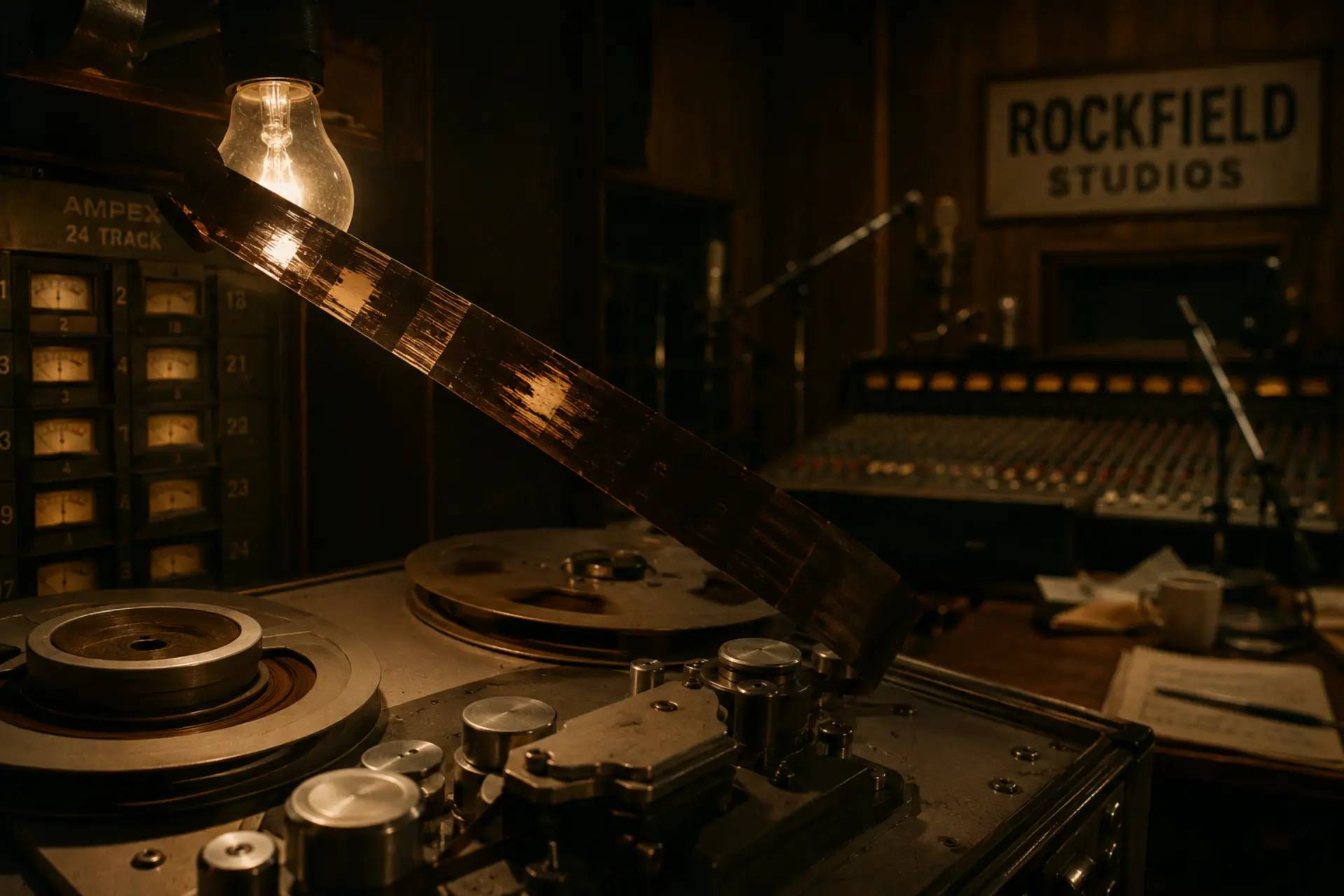
Recording began on August 24, 1975, at Rockfield Studios, a residential facility on a working farm near Monmouth in South Wales. The band—Freddie Mercury, Brian May, Roger Taylor and John Deacon—had already spent three weeks rehearsing at Penrhos Court in Herefordshire. Producer Roy Thomas Baker and engineer Mike Stone oversaw the work, with assistant engineer Gary Langan later involved in the London stages.
Mercury had written the song in sections. He first played a version for Baker at his Kensington flat, stopping midway to announce,
“This is where the opera section comes in,”
before they went out to dinner. What began as a short planned interlude expanded dramatically in the studio. Baker later recalled that every time Mercury arrived with additional “Galileos,” more blank tape was spliced onto the reel. The opera passage alone consumed roughly three weeks of ten- to twelve-hour days.
Studios of the era offered only 24-track analog machines. Mercury, May and Taylor layered their voices repeatedly—Mercury taking the middle register, May the lower parts, Taylor the highest falsetto lines—then bounced those takes down to free tracks for further overdubs. Contemporary accounts place the total number of vocal passes between 160 and 180. The process required successive generations of tape transfers, ultimately reaching eighth-generation copies for some elements.
The physical strain on the magnetic tape became impossible to ignore. Oxide coating rubbed away with each pass over the heads. May has described holding a section of the tape up to the light and seeing straight through it.
“We ran the tape through so many times it kept wearing out,”
he said.
“Once we held the tape up to the light and we could see straight through it, the music had practically vanished.”
Langan, who was present during the London vocal sessions, recalled noticing May repeatedly inspecting the tape and then announcing,
“You know what guys? I can see through this tape.”
NME journalist Julie Webb, present for some of the vocal work, observed the intensity of the process. According to music writer Gillian G. Gaar, author of the 2025 book Queen & A Night at the Opera: 50 Years, Webb remarked that for every “Galileo” that appears in the finished track the singers had performed the line roughly 120 times. Gaar recounted the episode in an interview on the Booked on Rock Podcast, noting that the band
“very quickly had to transfer it so that all this work wouldn’t get rubbed off.”
Baker acknowledged a sonic cost. With so many layers stacked on analog tape, some clarity was inevitably lost.
“There was some loss of sound,”
he said.
“You get that much on there, and you can’t hear everything that clearly.”
Yet when the completed opera section was finally played back, the band and production team were stunned by the result.
The basic backing tracks for the ballad and hard-rock sections had been cut at Rockfield. Further vocal and guitar overdubs continued at London studios including Sarm, Scorpio Sound, Roundhouse and Wessex. The finished six-minute track appeared on the album A Night at the Opera, released in late 1975, and as a single on October 31 of that year. Despite initial industry skepticism about its length and unconventional structure, it became one of the most enduring recordings in rock history.
The near-loss of the tape remains a frequently cited illustration of the technical limits of mid-1970s recording technology and of the extremes to which Queen pushed those limits to realize Mercury’s vision.