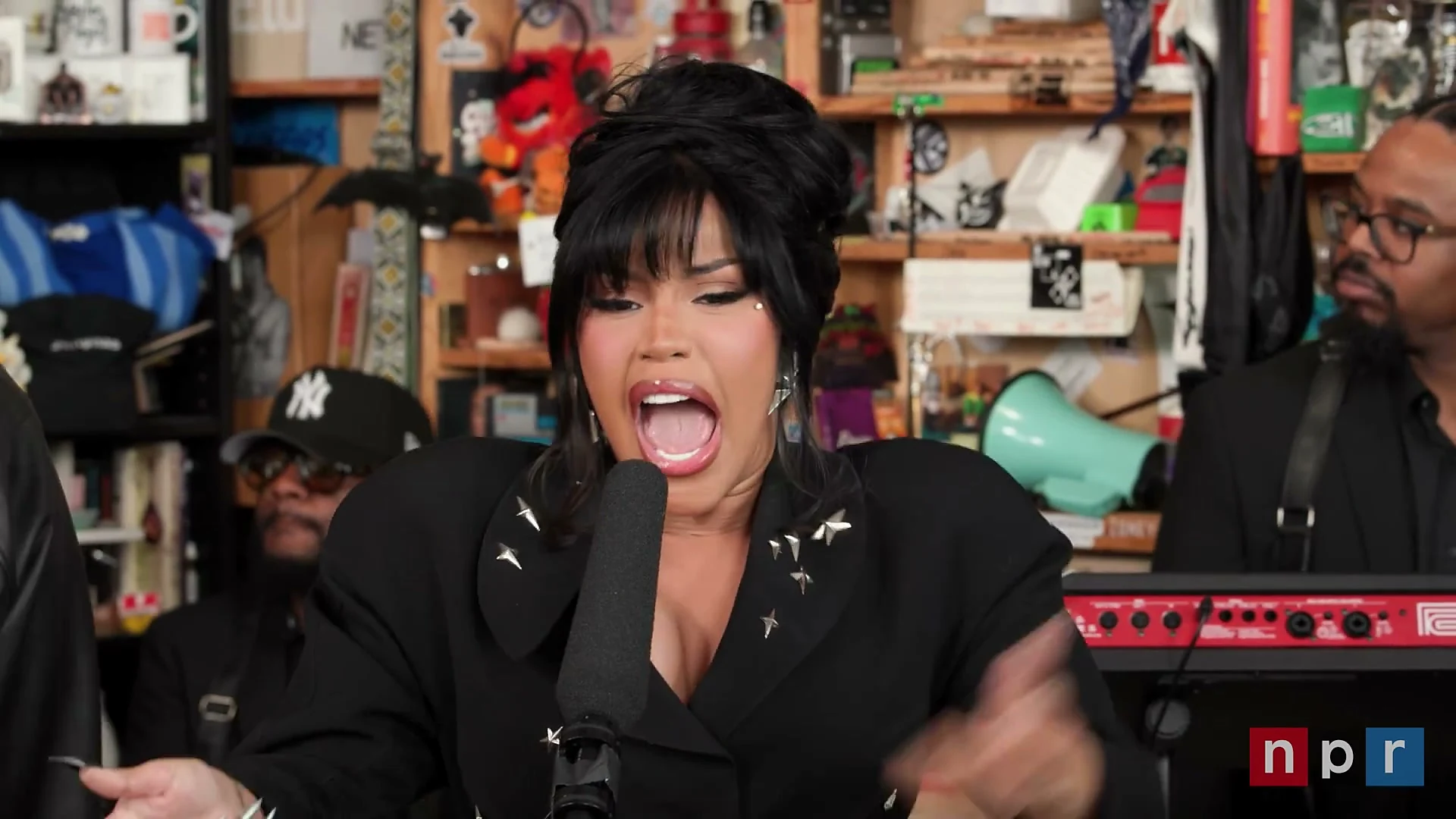
Cardi B did not walk into NPR’s office in Washington on Monday to be humbled. She walked in with a nine-piece band, a vintage Mugler jacket and a catalog old enough to be argued about, and she turned the Tiny Desk into the one thing the format almost never gets from a superstar: a stress test. Eight songs, 18 minutes, no 808 carrying the low end, no arena to hide in. The set premiered October 19 at noon Eastern, and by the time it ended the question was no longer whether the hits would survive without the club. It was whether the club had been holding them back.
NPR had to turn people away. Alanté Serene, who produced the episode, wrote in NPR’s own write-up of the set that word getting out about Cardi B drew one of the biggest crowds she has seen at the office, with people from all walks of life lined up outside. That detail matters more than any view count. Tiny Desk started as an acoustic curiosity beside a cubicle. It is now a credibility ritual, the stop where a rapper submits to a room with bad sightlines and good ears. Cardi did not treat it like a coronation. She treated it like a hearing.
Adam Blackstone was the reason it could be a hearing at all. The music director, bassist and Philadelphia native assembled a band with a horn section, two keyboardists, guitar, drums, a DJ and two background vocalists, then built arrangements that refused to imitate the records. There is no producer behind the glass to trigger the drop. Kenneth Whalum’s sax and Melvin Jones’s trumpet have to carry the hooks that synths usually own. Most of the time they do. When they do not, you can hear exactly what the record was doing for her.
She opened with “Hello,” which is either humility or a flex depending on how you hear it. “Hello, it’s me,” she repeats, and then, almost as a stage direction, “I’m back.” On the album it is a party record with a haunted synth line. Here it becomes an entrance, the band holding a minor-key vamp while she tests the room’s patience. Her breath control is the first technical surprise. Cardi has always been a punchline-heavy rapper, the kind who lands jokes in the pocket. On “Hello” she stretches phrases past the bar line and lets the consonants do the percussion.
“ErrTime” is where the set loosened its collar. The lyric is pure neighborhood bravado, “Somebody better get her ’cause she out here lookin’ fine,” a line that works because she sounds amused by her own reputation. Blackstone’s arrangement pushes it toward funk, the horns answering her ad-libs like a second vocalist, and the rhythm section never lets the groove get comfortable. This could have gone wrong. A live band can make a rap banger sound like a wedding reception. Here the rhythm section stayed dry and clipped, and DJ Ray G’s scratches filled the space where the producer’s vocal chop used to sit.
Then, at 9:43, she called the audible. “Change the vibes, change the vibes,” she said, half joking, and the room obeyed. What followed was the riskiest and best stretch of the set. “Man of Your Word” is not a hit in the way the rest of the list is. It is a confession, and the lyric is unusually plain: “Seven years, admit it wasn’t all bad.” Later she calls an ex “my twin” and “my person,” then adds the line that should end every argument about whether she can write: “you was me but the evil version.” The song does not ask for sympathy. It asks for accuracy.
Live, the song gained what the album version only suggests. Without the vocal stacking, you hear how much of the melody she is carrying herself, and how often she chooses the unpretty note because it tells the truth better. The confession that icon status is its own pressure landed differently in a room full of books and toys and NPR mugs. Cardi has spent a decade being discussed as a personality, and for four minutes she made the discussion feel small.
“Be Careful” followed, and the pairing was the smartest sequencing decision of the set. The 2018 single is a warning, not a ballad, but its spine is an interpolation of Lauryn Hill’s “Ex-Factor,” which means a live band can make the lineage audible. The keys and the background vocals turned the chorus into something closer to church than pop. “I wanna get married, like the Currys,” she raps, before correcting herself with “but we more like Belly, Tommy and Keisha shit.” It is a great joke and a great thesis: the fairy tale and the crime story are the same story with different lighting. The line “my heart is like a package with a fragile label on it” has always been the song’s best writing. In this arrangement, it finally had room to breathe.
The back half was a reminder that Cardi B’s biggest songs are built on instructions. “Up” is a command (“If it’s up, then it’s up, then it’s up, then it’s stuck”), “AH HA” is a shrug with a beat, and “Bodak Yellow” is a threat delivered as a receipt (“Got a bag and fixed my teeth”). The band handled “Up” best, mostly because the song’s structure is already percussive. “Bodak Yellow” was the night’s one genuine compromise: the horns were fun, and also too polite. That song needs subwoofer menace, the kind of low end that makes a room feel like it is leaning forward in its seat. A brass chart cannot fake that, and the arrangement did not try. It turned a threat into a parade, which is a different thing than a failure.
“I Like It” solved the problem by changing genres. The 2018 boogaloo record is the one Cardi hit that improves when humans play it, because the sample logic is already live instrumentation. The horns had something to do. The crowd had a chorus to shout. She danced between the musicians and handed out hugs at the end, and the room looked less like a concert and more like a block party that had been allowed indoors.
None of this makes the set flawless. The middle sagged in the way all ballad pivots sag, and the banter covered for a couple of transitions that the band had not quite solved. The rider bit, where she complained about celery sticks and carrots and asked for crab cakes, is genuinely funny, and it is also a magic trick: while the audience laughs, the band retunes. She did not preview anything from the third album she says she is recording. She also left “WAP,” “Money,” “Press” and “Get Up 10” on the table. For a rapper whose hardest pure-rap record might be “Get Up 10,” skipping it is a strange kind of humility.
The visual argument was just as deliberate. Cardi wore a vintage Thierry Mugler jacket with celestial studs, black latex pants and square-toe boots, a near-twin of a look Naomi Campbell wore on the designer’s fall 1990 runway, styled by Kollin Carter. Fans read Janet Jackson’s “Rhythm Nation” in the buckles, which is the correct reference and also the correct instinct: this was armor, not athleisure. The office did the rest. The Tiny Desk set is a wall of toys, records, mugs and a telephone that looks like it has never been answered. Against that clutter, her black silhouette read like a title card. NPR’s cameras stayed close and low, at eye level, with no haze and no LED wall. Proximity was the effect. You could see her decide where to breathe.
None of this timing is incidental, and that is what makes the set feel like a checkpoint rather than a comeback. Cardi turned 34 this month, and the last year has been a slow correction of a narrative that had her filed as a singles artist, a reset she had been signaling for months. “AM I THE DRAMA?” debuted at No. 1 on the Billboard 200 in 2025, making her the only female rapper to debut atop that chart with her first two albums, and she remains the first solo woman to win the Grammy for best rap album. Her Little Miss Drama tour sold out arenas across North America this year. On October 16, Billboard Canada named her the first-ever Global Woman of the Year, to be presented November 24 in Toronto. She has also told The Breakfast Club she plans to record a third album. The Tiny Desk arrived in the middle of that arc, which is why it feels like a checkpoint rather than a victory lap.
Blackstone’s arc runs parallel and mostly out of frame. He moved from New Jersey to Philadelphia in 2000, came up in pit bands and jazz clubs, and became the musical director of choice for Jay-Z, The Roots and Justin Timberlake. He won an Emmy for Rihanna’s Super Bowl halftime show and a Tony nomination for orchestrating Alicia Keys’ “Hell’s Kitchen.” In May, the Philadelphia Music Alliance inducted him into its 2026 Walk of Fame class, and he took the stage at the Kimmel Center while prepping Roots Picnic. His gift is translation: he takes a record built in a laptop and finds the human version of its logic. On this set, that meant knowing when to fill the room and when to leave her alone.
For Gen Z, the interesting part may be the format itself. The generation that grew up on 15-second hooks and reaction clips has been handed an 18-minute performance with no skip button, no jump cuts and a band that has to be watched. That is not a nostalgia play. It is an interface change. The Tiny Desk removes the two things short-form video provides for free: pace and permission to leave. What is left is a person singing in a room. Cardi is good at that, which is not the same skill as being good at being clipped.
Gen Alpha will meet these songs differently. “Up” and “I Like It” have already lived several lives as edits, dance challenges and family cookout staples. Hearing them played by a horn section is not a history lesson. It is a reminder that the versions floating in the feed came from somewhere, with a writer, a band and a room. The set gives them the source code, and it arrives at a moment when the genre has spent two years arguing about whether it is in a slump. An 18-minute live band set is one answer that does not require a think piece.
Hip-hop heads got their own Easter eggs. “Be Careful” carries Lauryn Hill’s “Ex-Factor.” Genius credits “Up” as an interpolation of Ice Cube’s “Once Upon a Time in the Projects.” “I Like It” is a boogaloo record that always wanted live brass. The band, not a track, had to make those references legible, and for most of the night it did. That is the part the discourse will miss. The set was not proof that Cardi can sing. It was proof that her catalog has enough architecture to be rebuilt in public, which puts her in a much smaller room than the one her fame built.
She is also doing this while the current wave of women in rap keeps raising the bar for live performance, which makes the choice to strip down rather than dress up feel less like vanity and more like competition. The easy move would have been a medley of hits with a track behind it. The harder move was to let a horn section and a drummer expose every seam in songs that were designed to be seamless.
By the end, she was hugging strangers and beaming, and the crowd was dancing behind the desk. It would be easy to call that a win and move on, but the more honest reading is that the Tiny Desk did not tame her. It isolated the part of her that had been hardest to hear through the noise: the writer who can make a threat, a joke and an apology sit in the same verse. The hits survived. More importantly, they had somewhere to go.